
Skip to content

PROJECT

From the Covid-19 pandemic, European countries learnt the importance of flexibility in funding and organization of health systems, but there are still several challenges for healthcare systems that require efficient and flexible financing mechanisms to be successfully addressed:

  • Empirical and theoretical gaps on the resilience of the healthcare systems in the EU;
  • Limited ability to demonstrate causal effects of financial incentives and reimbursement mechanisms;
  • Lack of reliable and comprehensive measures of hospital quality and its relationship with reimbursement mechanisms;
  • Lack of knowledge in understanding how better integrated care could make health systems more efficient and improve the quality of life for people with multi-chronicity;
  • Lack of consensus among policymakers on how to value and reimburse digital health technologies.

The Project

The FLASH project intends to be a game-changer in the European integrated healthcare system.

By focusing on budget allocation and financing of health services within a specific budget with a multidisciplinary approach, the project conducts an extensive investigation of healthcare financing mechanisms across Europe.

It tries to pinpoint and investigate the most significant factors that underline the link between the major problems facing healthcare systems and their funding.

It also intends to provide evidence on the ability of existing financing mechanisms and contracts to address such challenges and study new solutions to achieve more effective, efficient and equitable healthcare systems.

Objectives

  • Defining financing models that address health needs in an efficient and equitable way;
  • Identifying the key determinants of resilience of healthcare systems in order to improve the ability to face extreme events, as well as long-term structural changes;
  • Providing guidance on how better integration of healthcare services could enhance effectiveness and efficiency of healthcare provision;
  • Contributing to a better understanding of existing incentives and to development of new ones.

Expected Results

  • Building evidence on the nature and economic implications of the resilience and sustainability of healthcare providers during periods of pressure and/or health shocks;
  • Enabling authorities responsible of the provision of healthcare to better address financial challenges related to technological innovation;
  • Reaching a better understanding of how the allocation of resources could be improved to meet population’s needs;
  • Filling the empirical and theoretical gap in understanding the financing mechanisms adopted in Europe and identifying new possible models of financial incentives;
  • Developing a theoretical framework and practical methodologies to understand and manage patient mobility across EU countries;
  • Building evidence on how a better integrated health and social care services for old people could improve health access and promote better health.

Work Plan

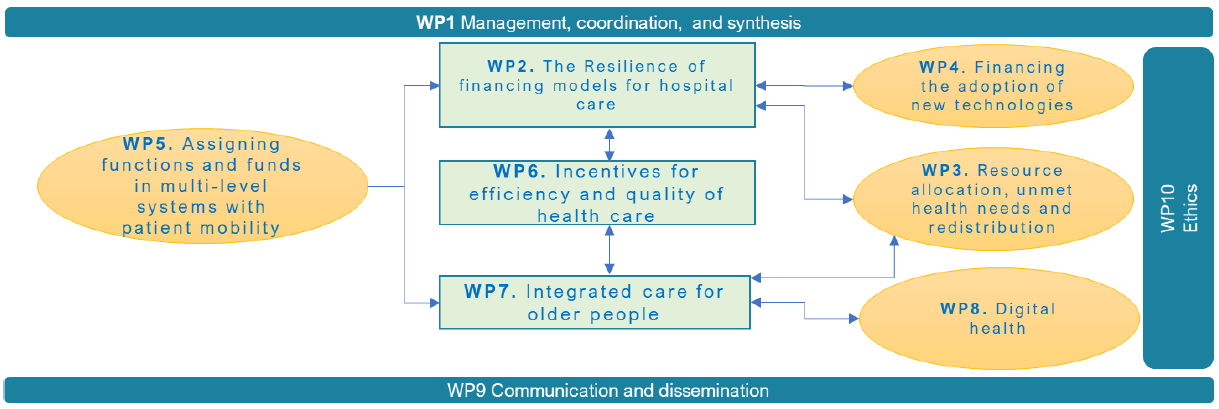
The FLASH project consists of 10 Work Packages (WPs):

  • WP1 –  Project management
  • WP2 seeks to boost healthcare system flexibility and resilience by developing a framework to assess hospital care resilience, mapping resilience in European health systems, and identifying financial solutions for demand-driven challenges.
  • WP3 explores solutions to improve the ability of financing mechanisms to address health needs and reduce inequality in access to healthcare.
  • WP4 seeks to create forecasting tools for payers to assess the financial and organizational impacts of new health technologies.
  • WP4 addresses challenges related to the impact of innovation on the costs and organization of the healthcare system.
  • WP5 explores the financial dimension of international patient mobility with the aim of enhancing care quality across EU Member States and narrowing disparities.
  • WP6 aims to evaluate the impact of a range of financial incentives targeting both primary and hospital care on patient outcomes and efficiency.
  • WP7 focuses on assessing the impact of integrated care for the elderly on health outcomes and expenditure. By adopting a comparative perspective, this will allow to identify best practices for care integration.
  • WP8 aims to assess the cost-effectiveness, impact and equity of digital health and provide guidance on its integration into healthcare through analysis, evidence-based recommendations and an examination of disparities in use.
  • WP9 – Communication and dissemination.
  • WP10 – Ethics.

The connections between WPs are shown in the Workflow diagram below.
Back To Top